If you are planning a small business website in Ghana in 2026, the goal is not to buy the most pages. The goal is to build the right structure: enough clarity and trust for people to understand the business and contact you without friction.
Many small business websites in Ghana go wrong in one of two ways. They are either too thin to answer the questions people already have, or they are padded with pages and effects that do not improve trust or inquiries. A useful site sits in the middle: clear structure, strong mobile use, visible contact paths, and the right proof.
Most small business websites in Ghana should start with a clear homepage, an about page, service or product pages, a contact page, and a visible WhatsApp or inquiry path.
They should also include:
- mobile-friendly layout
- real business details and trust signals
- clear calls to action
- simple navigation
- content that explains the offer properly
What should a small business website in Ghana actually do?
A small business website should help a visitor do four things quickly:
- understand what the business does
- see that the business is credible
- find the right service or product
- take the next step
That next step may be a phone call, a WhatsApp message, a form inquiry, or a visit to a physical location. The website does not need to do everything. It needs to support how your business already sells.
For many businesses in Ghana, most visitors are on mobile and may arrive from Google, Instagram, Facebook, or a shared WhatsApp link. That means the website must make sense fast. If the homepage is vague, the service pages are thin, or the contact path is hidden, the site will feel unfinished even if it looks polished.
If you are still working out budget, start with website cost in Ghana. If you are comparing providers, read website design in Ghana alongside this checklist. If you are still deciding whether social media is enough on its own, see website vs Instagram in Ghana.
The practical use of this guide is simple: use it before you approve a quote, before you sign off on page structure, and before the website goes live.
You can also use it as a question list for the company or freelancer building the website. If a provider cannot answer these points clearly, the scope is probably still too vague.
Which businesses need a website?
Not every business needs the same kind of website, but many small businesses reach a point where Instagram, WhatsApp, or referrals are no longer enough on their own.
That usually happens when the business needs to explain its offer more clearly, look more credible to new customers, or make inquiries easier to manage.
In Ghana, that can include:
- clinics and consultancies
- salons, repair shops, and local service businesses
- small agencies and studios
- food brands and other businesses that want to show products clearly before investing in full ecommerce
- schools, programs, or organizations that still need a simple public-facing site rather than something large
The details will change from one business to another, but the main job stays the same. The website should explain the offer clearly, make the business feel trustworthy, and give people an easy way to get in touch.
If the business already needs something more complex, such as a large content-heavy website, a member portal, or deeper internal workflows, then it may be moving beyond a simple small-business site.
Which pages should be on the site?
For most small businesses in Ghana, these are the core pages people expect to find. If a proposal skips several of them, the cheaper quote may simply be missing necessary work.
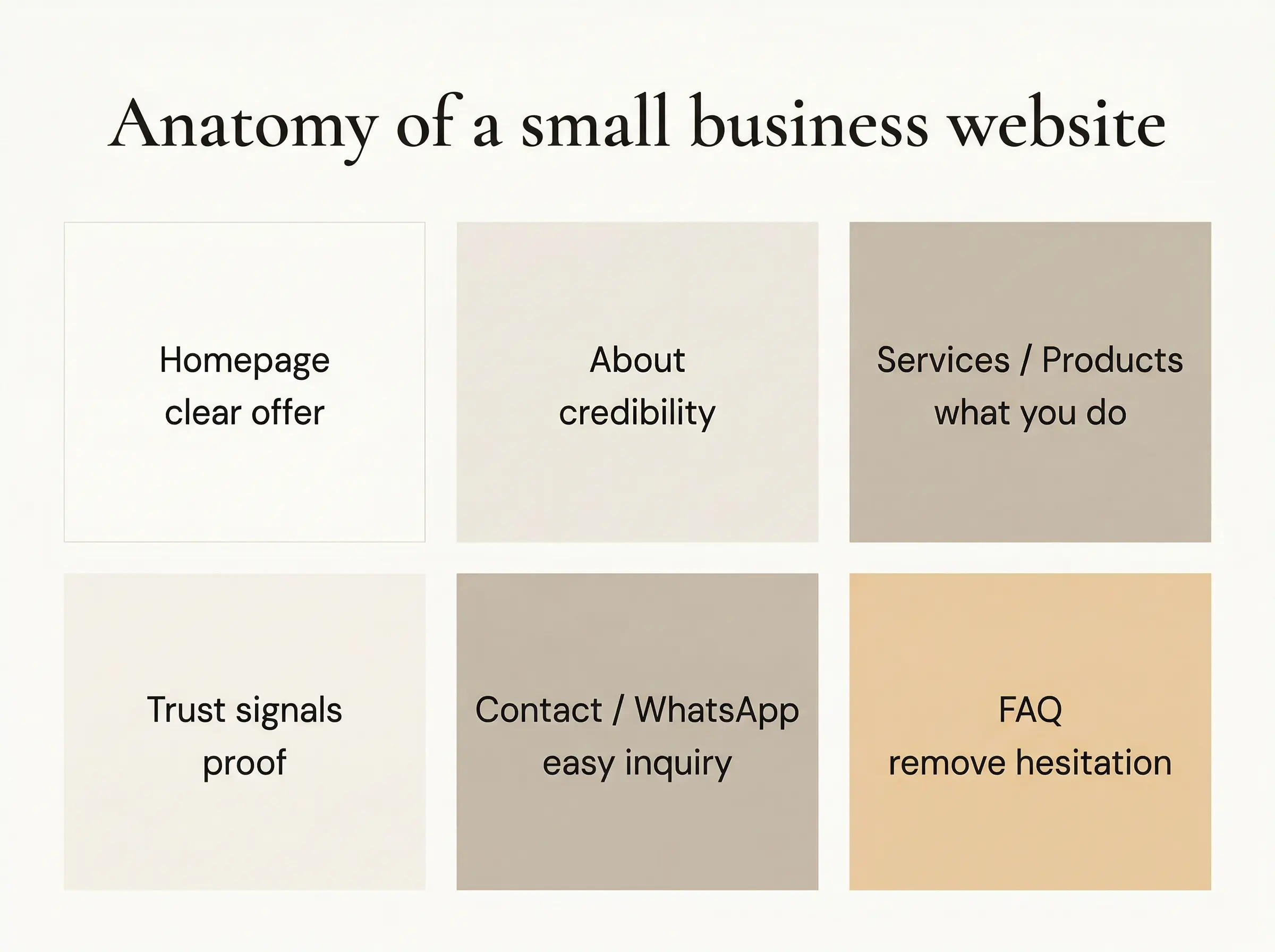
A simple structure for the core sections most small business websites need.
1. Homepage
The homepage should explain what the business does in plain language. It should not force someone to guess whether the business is relevant.
A good homepage usually includes:
- what the business offers
- who it helps
- a few trust signals
- the main next step
When reviewing a draft homepage, ask one question first: if someone lands here for 10 seconds, will they know what the business does and what to do next?
2. About page
This page builds credibility. It should help people understand who is behind the business, what the business stands for, and why they should trust it.
For local businesses, this can also include location context, years of work, team details, or a short business story when it is genuinely useful. If the about page is vague, people have less reason to trust the business behind the site.
Ask the provider: what exactly on this page is supposed to increase trust?
3. Services or products page
This is one of the most important parts of the website. Many small businesses have a homepage and contact page but never explain their actual offer well enough for someone to make a decision.
Each service or product section should answer:
- what the service is
- who it is for
- what problem it solves
- how someone gets started
If a provider sends a draft with strong visuals but weak service explanations, this is one of the first things to push back on.
Ask the provider: where does the site clearly explain what we offer, who it is for, and how someone gets started?
4. Contact page
The contact page should make inquiry easy, not formal for its own sake. No one should have to hunt for a next step.
In many Ghanaian businesses, that means including some combination of:
- phone number
- WhatsApp link
- email address
- contact form
- location or service area
Before launch, test every contact route yourself. Do not assume the form works, the WhatsApp link opens correctly, or the phone number is tappable on mobile just because it appears on the page.
Ask the provider: have all contact routes been tested on mobile, not just added to the layout?
5. FAQ or common questions section
This does not always need its own page at launch, but it should exist somewhere. FAQs remove hesitation at the decision stage. They can answer pricing approach, turnaround time, delivery areas, required documents, or what happens after a customer gets in touch.
If you already have real projects or outcomes to show, your website should also point people to proof. Even one or two credible examples on /work can do more than several paragraphs of generic claims.
What trust signals matter most?
Small business websites do not build trust through design alone. They build trust through evidence people can verify quickly.
Useful trust signals include:
- real business name and contact details
- real photos, work examples, or case studies
- client testimonials when available
- specific service descriptions instead of vague claims
- clear location or operating area
- policies and legal pages where relevant
When reviewing a website draft, check whether trust is being shown or merely claimed. A site that points to real work feels more credible than one that only says it is professional.
Ask the provider: what proof on this site would make a cautious customer trust us more?
For some businesses, a trust signal can be as simple as showing actual process. For others, it may be previous clients, certifications, delivery screenshots, or before-and-after examples. The exact form can change, but the principle is the same: show proof.
Why mobile design and contact flow matter so much
For many small businesses in Ghana, mobile is the main buying experience, not the secondary one.
Mobile quality is not just a design preference. It affects whether people can use the site properly and whether the structure is strong enough for search visibility. The practical takeaway is simple: do not treat mobile responsiveness as a bonus feature. Ask to see how the homepage, service pages, and contact flow work on a phone before approving the project. Google’s mobile-first indexing best practices explain why this matters.
That changes what matters. A website that feels acceptable on desktop can still fail if, on mobile:
- the text is hard to scan
- buttons are too small
- WhatsApp is hidden
- the form is frustrating
- pages load slowly
A small business website should make the contact path obvious on a phone. People should not need to scroll for too long before seeing how to act.
In practical terms, this often means:
- one primary call to action on each important page
- click-to-call where relevant
- a visible WhatsApp option
- short forms with only necessary fields
- clear section spacing so the page is easy to scan
If the site uses forms, keep them short and easy to complete on a phone. Check whether the form asks only for necessary information and whether it is easy to submit one-handed. Guidance on mobile form design basics is useful here because poor form design directly affects drop-off.
If a provider cannot show you a mobile version before launch, treat that as a process problem, not just a presentation gap.
Ask the provider: can you show me the homepage, key service page, and contact flow on a phone before I approve this?
What should a business prioritize first if budget is limited?
If budget is tight, do not spread the work across too many pages too early. Buy clarity first.
This is a practical order for many businesses:
- clear homepage
- strong services or products section
- simple contact path
- about page with basic trust signals
- mobile quality across the main pages
- FAQs or extra education pages later
That order works because many small business websites fail on clarity before they fail on features. People leave when they do not understand the offer, not because a site lacks extra sections.
If you are deciding whether to build now or keep relying on social media, the key question is whether social already gives you enough trust, structure, and control. If you are deciding who should build the site, compare providers based on scope clarity, mobile quality, and post-launch support rather than visuals alone.
Use the table below when you are forced to cut scope. Remove “add later” items first, not the pieces that explain the offer or capture inquiries.
Ask the provider: if we reduce budget, which parts should never be removed because they affect trust or inquiries?
| Must have now | Add later if needed |
|---|---|
| Homepage with clear offer | Blog or news section |
| Service or product details | Extra landing pages |
| About page | Deep resource library |
| Contact page and WhatsApp path | Animation-heavy sections |
| Basic trust signals | Advanced calculators or tools |
| Mobile-friendly layout | Secondary campaigns and experiments |
What do small business websites in Ghana often get wrong?
The most common issues are not always technical. They are usually structural, which means the user journey breaks before the design itself does.
Common mistakes include:
- a homepage that looks nice but does not explain the offer
- missing service details
- weak or hidden contact options
- relying on stock language instead of business-specific writing
- no proof that the business is real and active
- treating mobile responsiveness as optional
- adding too many pages before the important pages are clear
Another common problem is copying what larger companies do without matching it to the real needs of a smaller business. A small business site should be simple, but not thin.
This matters when reviewing proposals too. More pages and more effects do not automatically mean better value. Judge the proposal by whether it improves clarity, trust, and inquiry flow.
Ask the provider: which items in this proposal directly help us get more qualified inquiries?
A simple checklist you can use
Use this before launch or as an audit of an existing website. It works best as a sign-off checklist before you approve the final build.
| Item | Should it be there? |
|---|---|
| Clear statement of what the business does | Yes |
| About page with real business details | Yes |
| Service or product information | Yes |
| Contact page with at least 2 contact options | Yes |
| WhatsApp or inquiry path visible on mobile | Yes |
| Basic trust signals | Yes |
| Mobile-friendly layout | Yes |
| FAQ or common objections answered somewhere | Yes |
| Links to real work or proof where possible | Yes |
| Extra pages added only after the core is clear | Yes |
If several of these are missing, the website is probably not doing enough yet to justify what you are paying for.
Use this checklist as a planning document, not just a launch audit. It is easier to get the right structure upfront than to pay for a redesign later. If your current site already exists but underperforms, review whether the problem is design, structure, or trust content before rebuilding from scratch.
Frequently asked questions
How many pages does a small business website in Ghana need?
Many small businesses can start with four to six strong pages rather than a large site. What matters is whether the important pages are clear and complete enough to make someone contact you.
Does every small business website need a WhatsApp link?
Not always, but many do. If WhatsApp is a real part of how the business handles inquiries in Ghana, the website should reflect that instead of forcing a less natural path. The buyer question is whether customers actually prefer it, not whether it feels modern.
Should a small business website include pricing?
Sometimes. If exact pricing varies, the site can still explain pricing approach, ranges, or what affects cost. That often helps qualify inquiries better than saying nothing. If pricing clarity matters, review the dedicated website cost in Ghana guide as part of your planning.
What is the most important page on a small business website?
Usually the homepage or the main services page. Those are often the first places where people decide whether the business is relevant and trustworthy enough to continue. If those pages are weak, the rest of the site matters less.
Can a small business website in Ghana be simple and still professional?
Yes. Professional does not mean complicated. It means the website is clear, credible, mobile-friendly, and easy to act on. In practice, that usually means paying for stronger fundamentals, not for more visual effects.
Is Instagram enough instead of a website?
For some very early businesses, maybe for a while. But once the business needs stronger search visibility, clearer structure, better trust, or more control over the customer journey, a website becomes more important. That is the point where a business should treat a website as an operating asset, not just an online placeholder. For a fuller breakdown of where that line usually is, read website vs Instagram in Ghana.