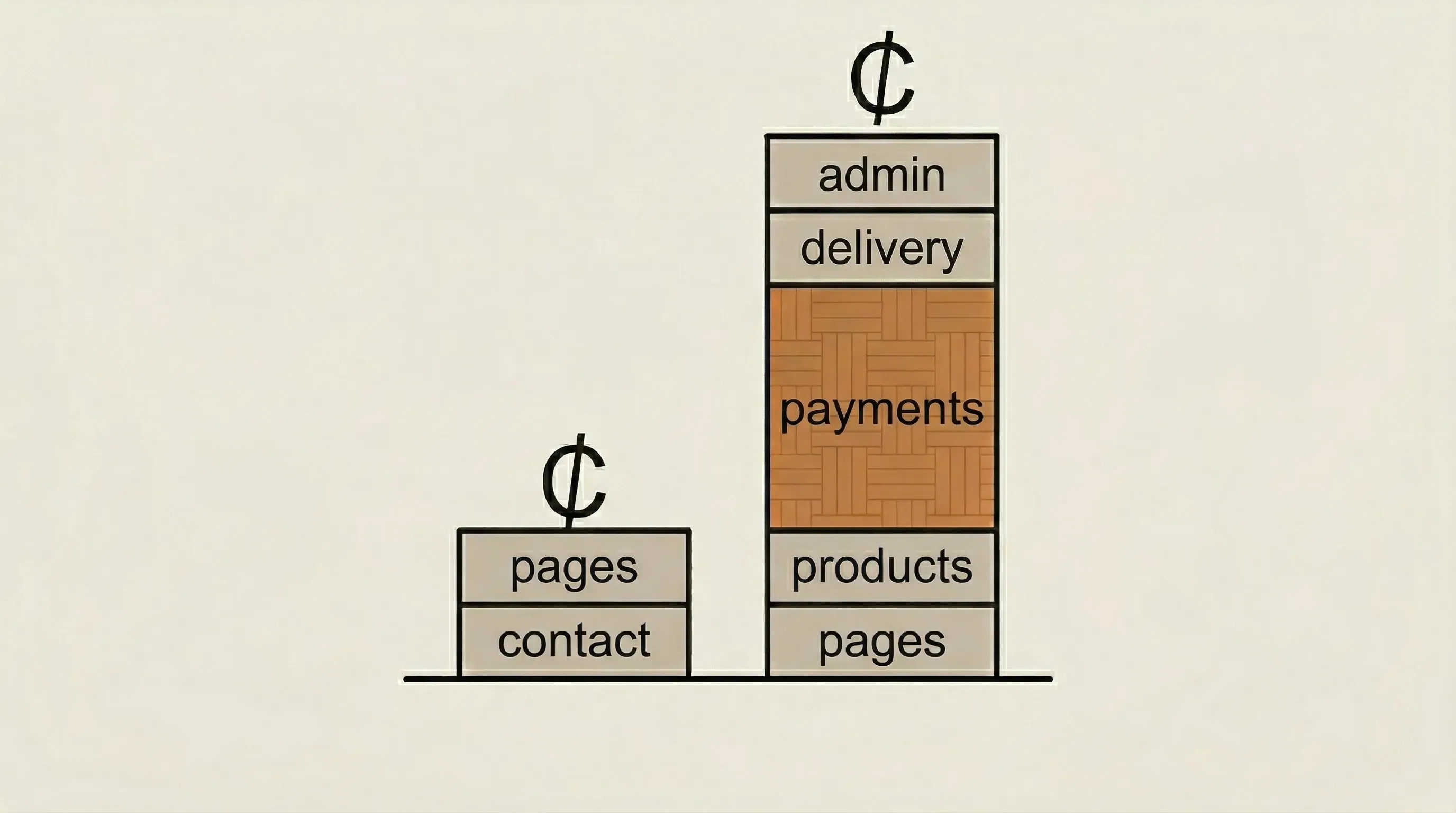
If you are trying to estimate what it costs to build an online store in Ghana in 2026, the main thing to know is that ecommerce websites usually cost more than standard business websites because they need more than pages and contact forms.
Once a website has products, payments, delivery logic, order management, and customer communication, the scope grows fast. In Ghana, ecommerce planning also has to account for local payment behaviour, delivery workflows, mobile checkout quality, and who inside the business will manage products after launch.
For many businesses in Ghana, a basic professionally built online store usually starts around GHS 7,000 to GHS 12,000 and can move above GHS 20,000+ as product count, payment setup, delivery logic, content depth, and custom functionality increase.
Final cost usually depends on:
- how many products and categories the store has
- whether the business needs a simple catalog or full checkout flow
- how payments will work
- how delivery or pickup will be handled
- whether product content and imagery are ready
- whether the store is template-based or custom
- whether post-launch support is included
Why ecommerce websites cost more than standard websites
A normal business website mainly needs structure, copy, trust signals, and a contact path.
An ecommerce website needs those things too, but it also needs operations.
That usually means extra work around:
- product catalog setup
- category structure
- product filtering
- cart and checkout flow
- payment integration
- delivery or pickup logic
- automated emails
- admin setup
- stock handling or inventory workflow
- post-purchase experience
That is why an online store website in Ghana should not be priced like a brochure website with a few extra product pictures.
If you need a broader benchmark across all website types first, start with website cost in Ghana. This page goes deeper on what changes once the website has to function as a store.
Ecommerce website cost in Ghana: planning ranges
Use these as planning ranges, not fixed package prices.
| Ecommerce website type | Price range (GHS) |
|---|---|
| Starter catalog store | 7k-12k |
| Growing online store | 12k-20k |
| Operations-heavy ecommerce store | 20k-40k+ |
The key signal is complexity. Once the store becomes an operations system rather than a simple product catalog with checkout, the cost range widens quickly.
What affects ecommerce website pricing in Ghana?
Product count and catalog complexity
A store with 12 products is different from a store with 300 products.
Cost changes when the business needs:
- many categories
- product variants such as size, colour, or weight
- product filters
- related-product logic
- product migration from another platform
- bulk product uploads
The more catalog structure a store needs, the more setup, testing, and content work is involved.
Payment setup
In Ghana, payment choices matter a lot.
Some stores may need only one payment method. Others may need a combination such as:
- Mobile Money
- card payments
- bank transfer support
- pay-on-delivery workflow
Payment setup affects both technical work and customer experience. A weak checkout flow can reduce trust even if the rest of the site looks good.
Delivery and fulfillment logic
This is one of the most underestimated parts of ecommerce cost.
A business has to decide:
- how delivery fees are calculated
- which areas are covered
- whether delivery differs by product type
- whether pickup is available
- who updates order status
- what happens after payment is received
A store without clear delivery logic may still launch, but it usually creates friction very quickly.
Product content readiness
Many businesses assume the build team will somehow solve missing product data during the project.
But ecommerce projects slow down when the business does not yet have:
- product names
- descriptions
- pricing
- product photos
- SKU or stock data
- category structure
When those things are incomplete, the project cost may rise because more content cleanup and admin work is needed.
Template-based vs custom design
Some stores can launch well on a strong template setup with careful customization.
Others need more custom work because they have:
- unusual product flows
- stronger brand requirements
- more demanding mobile UX needs
- special landing pages
- content-heavy merchandising
Custom design usually increases cost because the work goes beyond setup into deeper planning, design, and implementation. If you are comparing proposals, website design in Ghana: what small businesses pay for gives the wider context for what is actually worth paying for.
Post-launch support
For ecommerce, launch is not the end.
The business often still needs help with:
- store admin training
- small layout fixes
- payment testing
- delivery rule updates
- product upload guidance
- performance fixes
- checkout issues
That is why post-launch support matters more for ecommerce than it does for a simple brochure website.
What is usually included vs what costs extra?
Most ecommerce build quotes in Ghana include design and development, homepage and key store pages, product and category templates, cart and checkout setup, basic payment integration, mobile responsiveness, policy pages, and launch support.
What often surprises businesses is what sits outside the main project fee: domain renewal, hosting, premium tools, product data cleanup, large product uploads, delivery complexity, photography, and ongoing maintenance.
Before you approve any ecommerce quote, ask for two totals in writing:
- launch cost
- expected annual or monthly running cost
Ghana-specific ecommerce decisions that affect budget
Ecommerce in Ghana is not only about putting products online. The store still has to match how customers buy and how the business operates.
That often means making decisions around:
- whether checkout should support Mobile Money directly
- whether customers expect to confirm orders on WhatsApp
- whether the business is delivering only in Accra or nationwide
- whether stock is updated manually or from another system
- whether customer trust needs stronger proof before online payment
A store built without those realities in mind may still launch, but it often underperforms because the buying journey feels disconnected from how customers actually shop.
Why a cheap ecommerce website can become expensive later
Cheap ecommerce websites usually fail in one of three ways.
Weak store structure
The catalog is hard to browse, product pages are thin, and customers cannot find what they need easily.
Weak checkout and operations
Payment or delivery rules are unclear, order handling becomes manual chaos, and staff spend too much time fixing basic workflow issues.
Weak long-term maintainability
The business cannot update the store confidently, product uploads become painful, and the whole system needs rebuilding too soon.
That is why the cheapest quote can still become the most expensive decision if the store has to be rebuilt after a short time.
Sample ecommerce website scenarios
These are planning scenarios, not package quotes.
Scenario 1: Small product catalog for a local brand
A business sells about 15 to 25 products, mostly to customers in Accra. It needs:
- homepage
- category pages
- product pages
- cart and checkout
- Mobile Money and card payment
- delivery fee setup for a small service area
- basic policy pages
A project like this may sit around GHS 7,000 to GHS 12,000 if product content is already prepared and the store does not need custom functionality.
Scenario 2: Growing online store with stronger structure
A business has 60 to 120 products, multiple categories, and wants a better store experience with stronger product filters, cleaner mobile flow, and some support with product content setup.
A project like this may sit around GHS 12,000 to GHS 20,000 depending on how much of the catalog and content work is already ready.
Scenario 3: Operations-heavy ecommerce build
A business has a larger catalog, more delivery rules, more product variants, and needs stronger automation or deeper operational logic after checkout.
A project like this may move above GHS 20,000 and can continue upward if the store starts to behave more like a custom system than a basic online shop.
What should you ask before approving an ecommerce quote?
Before you approve a quote, ask:
- how many products and categories does this quote assume?
- what payment methods are included?
- what delivery logic is included?
- how many products will be uploaded at launch?
- are policy pages and customer emails included?
- what support happens after launch?
- what costs recur every year or every month?
- who will maintain products, orders, and store updates after handover?
Those questions usually tell you more than the headline price.
Frequently asked questions
How much does an ecommerce website cost in Ghana?
For many stores, a practical planning range starts around GHS 7,000 to GHS 12,000 and can rise above GHS 20,000+ as catalog size, delivery logic, payment setup, and custom work increase.
Why is an online store more expensive than a normal business website?
Because it has to handle products, checkout, payments, delivery, admin workflow, and post-purchase communication, not just page design.
Is Mobile Money support part of ecommerce cost?
Sometimes yes, sometimes no. It depends on how the store is being built and which payment setup the business needs. This should always be clarified before approval.
Can a small business start with a simpler ecommerce website first?
Yes. Many businesses can launch with a leaner store first, especially if the catalog is small and the delivery model is simple. The important thing is making sure the structure is still strong enough to grow.