teache is a planning workspace for Ghanaian teachers: one place to plan a whole term, where schemes of work, lesson notes, class tests, exams, and marking schemes all come out mapped to the national curriculum and ready to print and sign. It runs on Ghana’s basic curriculum from B1 through B9, covering more than 4,000 NaCCA indicators, so every document carries the correct strand, sub-strand, content standard, and indicator codes. That is what makes it vettable rather than merely well written.
The brief
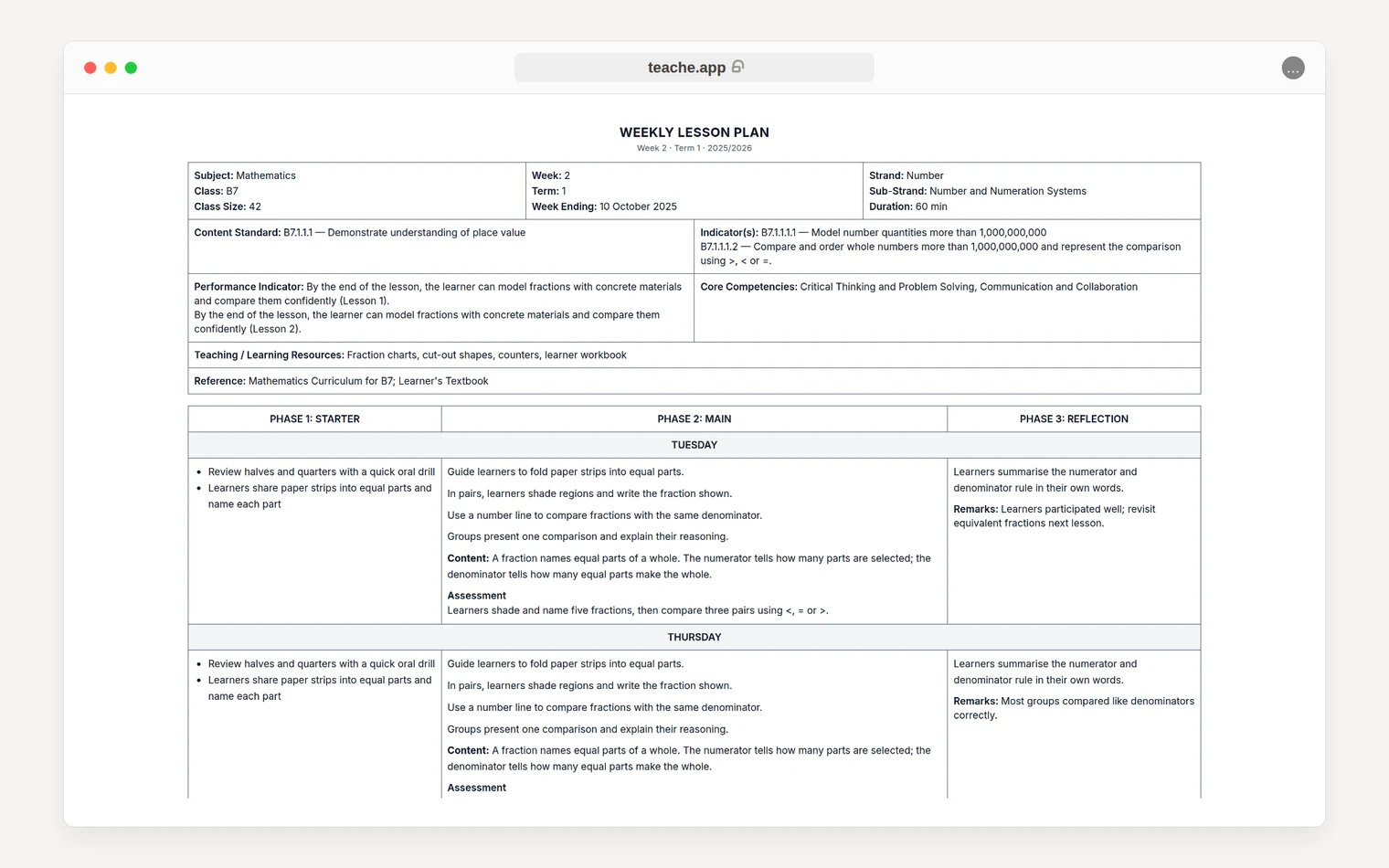
A weekly lesson note has a fixed shape: a header grid with subject, class, strand, and content standard, then a band for each teaching day split into starter, main activity, and reflection, then assessment, remarks, and the block where the headteacher signs off. The format is settled. Filling it in is what costs the evening, week after week, for every subject.
We wanted to give that time back without taking the teacher out of the loop. Generic lesson content fails here, because the headteacher rejects it and the teacher has lost the evening anyway. So the target was a note that survives vetting: correct codes, correct structure, and content pitched at the class actually sitting in the room.
Three constraints followed. The export had to be a real GES document before anything else got clever. The curriculum had to be the spine, so drafts anchor to indicators rather than to a model’s general sense of what a Ghanaian science lesson looks like. And the teacher had to stay in control, because they know their class size, their resources, and which pupils need the work pitched differently.
How it works
A teacher sets their class context once: class size, available resources, language, and ability spread. Every draft after that adapts to it, and they can seed a plan with extra context as free text or as a photo of notes they have already written.
From there the workspace runs at two speeds. In Guided mode it drafts one field at a time while the teacher reviews, steers, and accepts each one; asking it to make the main activity group work is a normal thing to do mid-draft. In Generate mode it drafts and commits every field across the week unattended, and the teacher downloads the result to edit offline. Both run on the same engine, so the difference is pacing.
What comes out is an editable Word document or a printable PDF, carrying the header grid, day-by-day phases, and the approval block. Bold text, lists, and tables render identically on screen, in print, and in the .docx, which matters because a note that reflows badly in Word is a note the teacher fixes by hand.
How we built it
We started in June 2026 and shipped weekly lesson notes ready to sign on June 20. A new front door landed on June 27, every JHS subject came on board by July 2, and the whole primary curriculum was seeded by July 5. Google sign-in and better-grounded drafts followed on July 6, and schemes of work paced from the curriculum arrived on July 8.
Seeding the curriculum before broadening the feature set shaped everything after it. Once the indicator tree was in the database, each new document type became a question of layout and prompting rather than fresh research.
We were equally strict about the export. A single layout struct feeds both the HTML and the Word renderers, so what a teacher sees on screen cannot drift from what lands in the document they hand in. That logic is pure and unit-tested, and it is the reason the note is trustworthy.
What it costs
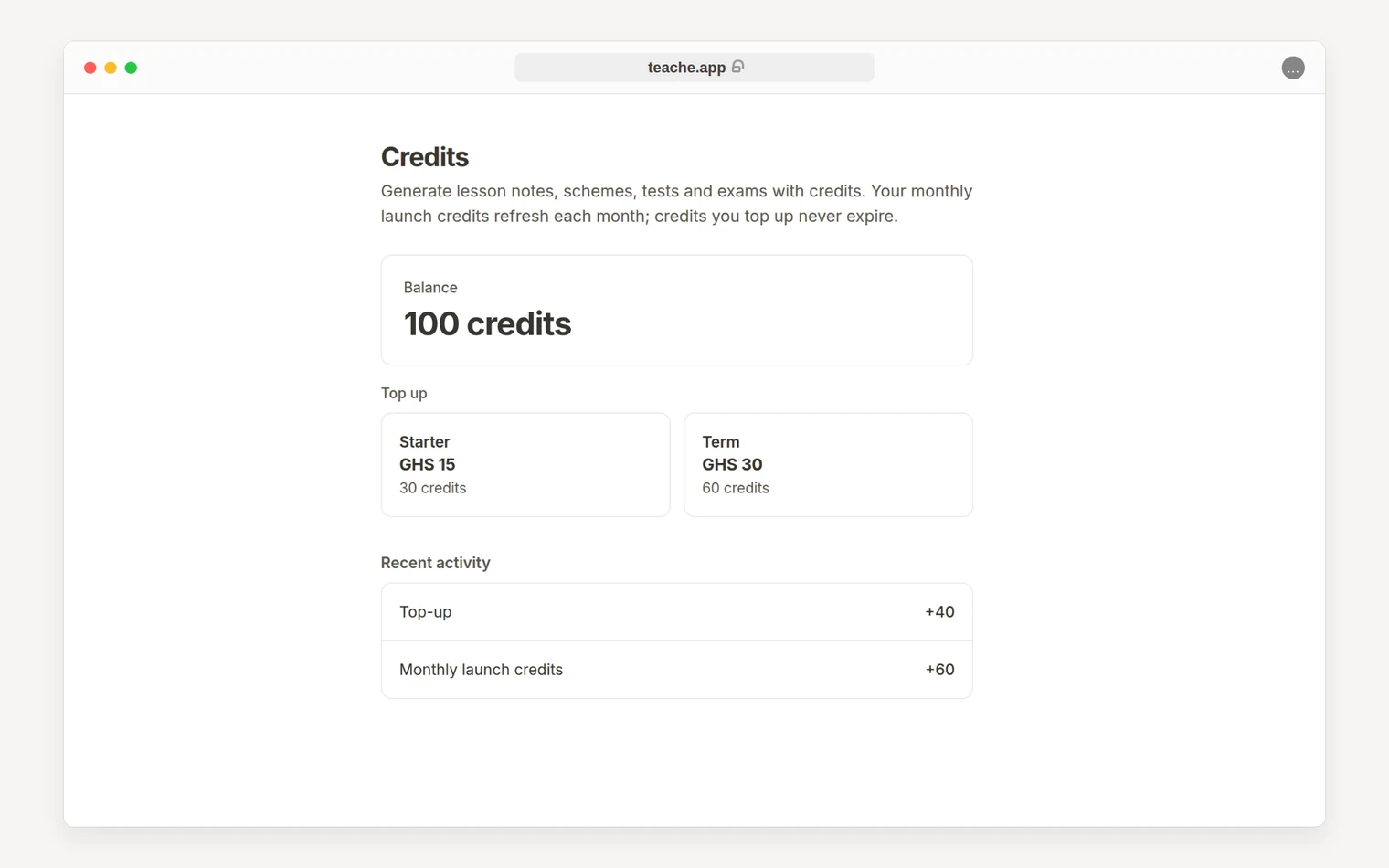
Planning runs on credits instead of a subscription. Every month brings a fresh allocation of launch credits, and top-up packs start at GHS 15 and never expire. A lesson note costs 5 credits, a marking scheme 6, a class test 8, a scheme of work 12, and an exam 20. Regenerating a document you already paid for is free, and payment goes through Mobile Money or card.
What comes next
The roadmap ahead is short and teacher-facing: a referral program, and a community where teachers can share what they have planned.
Share this case study