Someone in your area opened Google this morning and searched for exactly what you sell. They did not see your business. They saw three of your competitors, each with photos, reviews, and a phone number visible in the search results. The customer called one of them before you knew the search happened.
This is happening every day in Ghana. Google accounts for over 97 percent of all search traffic in the country (StatCounter, 2025). Nearly half of all searches have local intent (Google, 2025): “plumber near me,” “catering Tema,” “best salon Accra.” If your business does not show up for those searches, the customers go to whoever does.
The tool that determines who shows up is Google Business Profile. It is free. It takes a few hours to set up and less than an hour a week to maintain. It is the single highest-return growth tool available to a small business in Ghana right now.
Google Business Profile is free and it is the highest-return growth tool available to a Ghana business right now. The essentials:
- A complete profile gets up to 7 times more clicks than an incomplete one.
- Reviews are the difference between getting the call and getting ignored. A business with 50 plus reviews is 266 percent more likely to appear in the Local Pack.
- Fresh photos and weekly posts signal that your business is active. Profiles with an active photo library get 42 percent more direction requests.
- Consistency compounds. A few minutes every week outperforms a onetime setup left to go stale.
What happens when someone searches
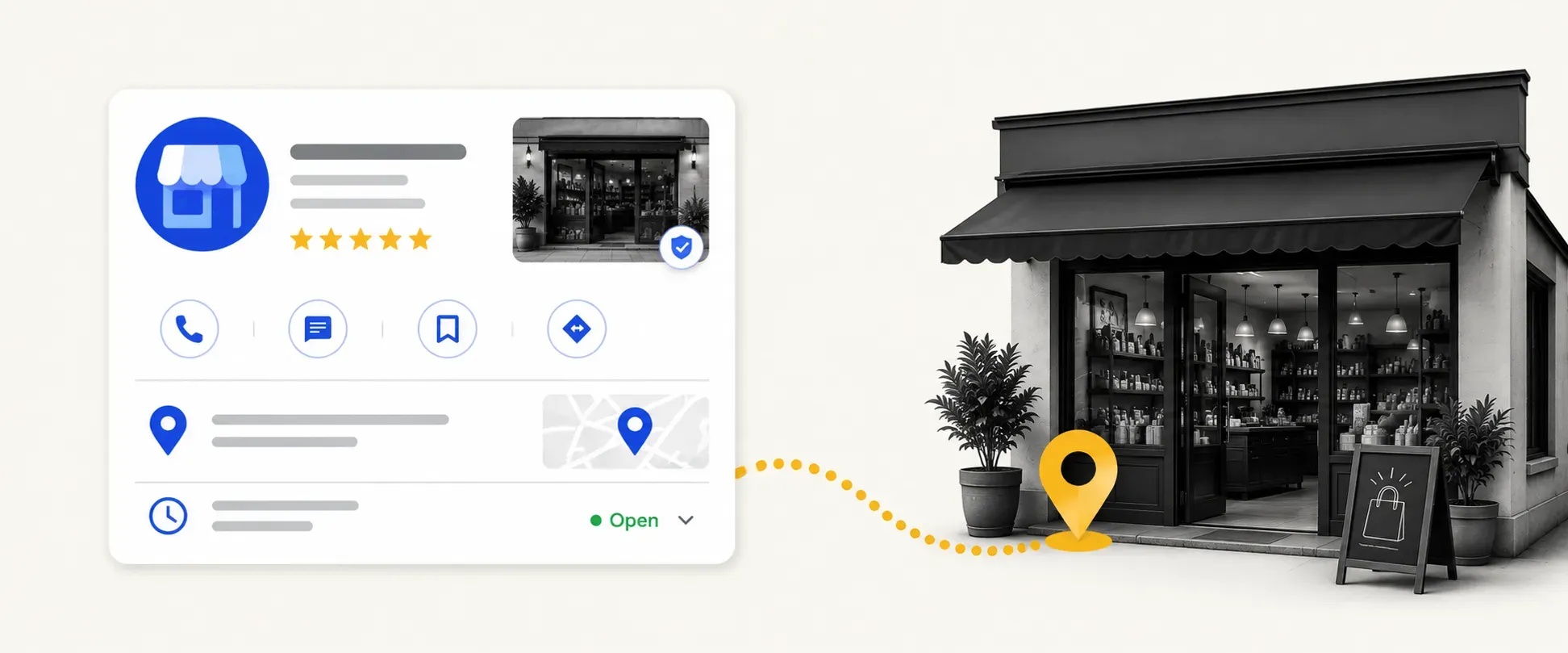
When a person searches for a local service on Google, the results they see follow a predictable pattern. The top section is often the Local Pack: three business listings with star ratings, addresses, and call buttons, pulled from Google Business Profile. Below that are organic website results. Then more listings.
42 to 44 percent of clicks on local searches go to the Local Pack (SearchLab, 2026). If your business is not in those three spots, you are invisible to nearly half the people searching.
Three factors determine who appears in the Local Pack:
Relevance. How well your profile matches what the person searched for. This is driven by your business category, the services you list, and the information in your description. A business categorised as “electrician” will not show up for “plumber near me” no matter how good its reviews are.
Distance. How close your business is to the person searching or the location they specified. You cannot control this beyond stating your address accurately.
Prominence. How well-known and trusted your business appears to Google. Reviews, photos, posts, Q&A activity, and the number of other websites that mention your business all feed into this.
Distance you cannot change. Prominence and relevance you can.
What converts a search into a customer
Showing up is step one. Getting the person to call, visit, or message is step two. A complete profile converts better than an incomplete one because it answers the questions a customer has at the moment of search.
Photos: what makes a customer pick you
Profiles with 100 or more photos get 42 percent more direction requests than profiles with fewer than 10 photos (SearchLab, 2026). The reason is straightforward: a customer deciding between three listings will pick the one they can see.
Upload photos of your shopfront, interior, team, products, and completed work. Phone photos are fine. Stock images work against you because customers recognise them immediately and they reduce trust. Add two to four new photos per month. Google tracks photo freshness as a signal that your business is active.
Reviews: what customers trust before they call
97 percent of consumers read online reviews before contacting a local business (BrightLocal, 2025). A listing with 50 plus reviews is 266 percent more likely to appear in the Local Pack than one with fewer than 10 (SearchLab, 2026). A business with three reviews from 2022 will lose the click to a competitor with steady recent reviews, even if the nearer business has fewer.
How you get reviews matters. The most effective method is to ask, right after you have delivered a good service, while the customer is satisfied. Google Business Profile generates a short review link you can share by WhatsApp, email, or text. Send the link immediately. A short WhatsApp message with the review link and a sentence of thanks converts better than a generic email.
Do not ask 50 people to review on the same day. Google detects unnatural patterns and removes them. In 2025, Google removed 292 million policy-violating reviews (Google Trust & Safety, 2025). Steady, genuine reviews over time build both customer trust and algorithmic trust.
Review velocity, meaning how frequently you get new reviews, now matters more than total review count. Twenty reviews in the last month can outperform two hundred old ones. The algorithm interprets steady new reviews as evidence the business is active and satisfying customers.
How you respond to reviews also matters. Respond to every review within a day or two. Thank the person by name. If the review mentions a specific service or product, reference it. A personalised reply shows future customers that you pay attention. Copy and pasted responses do the opposite.
For negative reviews, do not argue. Acknowledge the issue, apologise briefly, and offer to resolve it offline. Take the conversation to a phone call or WhatsApp. Other customers read your response more carefully than they read the complaint. A professional reply to a bad review builds more trust than a dozen five-star ratings with no response.
Posts: free weekly advertising
Google Business Profile posts appear directly in your listing on Search and Maps. They expire after seven days. They do not directly boost your ranking. What they do is occupy space in your profile that would otherwise be empty or show competitor content, and they signal that your business is operational.
Each post needs a photo, two to three sentences of text, and a call-to-action button like Call, Learn More, or Get Directions. What to post:
- A product that arrived this week
- A completed client project with a photo of the result
- A seasonal offer or price update
- A tip or advice related to what you sell
- An announcement: new opening hours, new location, new service
Posting two or three times a week is ideal. Once a week is enough to see a difference. A post takes two minutes from your phone.
Services and products: be specific
The services section tells Google exactly what you offer. Each service gets a name up to 80 characters and a description up to 300 characters. Do not write “Plumbing.” Write “Emergency plumbing repairs in Accra, available 24/7.” The more specific the service description, the more likely you are to match a specific search. Fifteen to twenty-five well-described services is better than three vague ones.
If you sell products, list them. Google’s product catalogue now feeds into Shopping results and AI-generated place summaries. A business with products listed can appear when someone searches “where to buy fresh bread near me,” while a business with an empty product section cannot.
Questions and answers: control the conversation
The Q&A section on your profile lets anyone ask a question publicly. Businesses that actively manage Q&A get 35 percent more clicks to their website (SearchLab, 2026). You want to control what appears there before a random user asks something you would rather not have on your listing. Seed five to ten common questions and answer them yourself:
- “Do you offer delivery to [your city]?”
- “What are your opening hours on public holidays?”
- “Do you accept Mobile Money?”
- “Is there parking available?”
Answer within 24 hours. Google tracks response time. An unattended Q&A section with unanswered questions from six months ago signals neglect.
Attributes: the details that filter you in
Attributes are tags that describe your business: wheelchair accessible, free Wi-Fi, women-owned, accepts Mobile Money, outdoor seating, online appointments. These appear as filters in Maps and as chips in search results. A customer who filters for “accepts Mobile Money” will not see your business if you have not selected that attribute.
Select every attribute that genuinely applies. Google can remove attributes automatically if a review contradicts them.
Mistakes that cost customers
Most Ghana businesses with a Google Business Profile have one. Very few have one that is complete and maintained. The gap is not skill. It is knowing what to fix.
Wrong or missing opening hours
A customer searches “restaurant open now.” Your profile says you close at 6pm. It is 5:45pm. They stay home because they do not think they will make it, even though you actually stay open until 9pm. Hours that do not match reality are worse than no profile at all. Update your hours every time they change. Check them after public holidays.
No photos or outdated photos
A listing without photos looks abandoned. A listing with photos from 2021 showing a different shopfront looks misleading. Upload real, current photos. Do not use stock images. Customers spot them instantly and they reduce trust.
Ignoring reviews
A business with ten unanswered reviews, including a two-star complaint from three months ago, tells a customer everything they need to know. Responding to reviews is not optional. It is part of the product.
Incomplete or vague service descriptions
“Services: General services.” This tells Google nothing and tells a customer nothing. List every service with enough detail that a person searching for something specific finds exactly your listing.
Duplicate or unclaimed profiles
If your business moved location or changed name and the old profile was not properly closed, you may have two profiles competing against each other. Both rank poorly. Verify that only one profile exists for your business. If there are duplicates, request their removal through Google support.
Wrong map pin location
Addresses in Ghana do not always resolve cleanly on Google Maps. A pin placed incorrectly means customers get sent to the wrong building or a different street entirely. Check your pin location by opening your listing and selecting “directions.” If the pin lands in the wrong place, adjust it. The pin should be on your exact building, not somewhere on the street.
Measuring whether it is working
Google Business Profile Insights shows you exactly how customers find and interact with your listing. The data is free and updates daily.
The metrics that matter for growth:
How customers found you. Insights splits searches into direct (your business name), discovery (your category or service), and branded (related to your brand). The number that tells you whether your optimisation is working is discovery searches. If this number rises month over month, more people are finding you without knowing your name.
What they did next. Calls, direction requests, website clicks, and messages. These are leads. Track them monthly. A rise in discovery searches without a corresponding rise in actions means people are seeing you but not converting. That tells you where to fix: photos, reviews, service descriptions.
Where they came from. Insights shows the city or area where searchers were located. If most of your calls come from a neighbourhood you do not serve directly, that is useful information.
Photo and post performance. Insights shows how your photos compare to similar businesses. If a competitor’s photos are getting more views, look at what they are posting.
Check Insights once a month. Fifteen minutes. The trends matter more than any single day.
Frequently asked questions
How long does it take to see results?
Most businesses see an increase in calls and direction requests within two to four weeks of completing their profile and adding photos. The full effect from reviews and regular posting builds over three to six months. This is not a quick fix. It compounds.
Does this work if I do not have a website?
Yes. A Google Business Profile works independently of a website. Your listing includes your phone number, address, hours, photos, and a link for directions. A customer can find you, call you, and visit you without ever leaving Google. That said, a website gives customers more information and a place to learn about your services in depth. The two work together. For help deciding, see website vs Instagram for Ghana businesses.
How do I get verified?
Video verification is now the default. Google will ask you to record a short video of your business location, showing your signage, the street outside, and your workspace. Keep your phone steady and capture as much identifying detail as possible. If video is not an option, postcard verification takes five to fourteen days.
What if someone leaves a fake negative review?
Flag it through the Google Business Profile manager. Google will review and remove reviews that violate its policies. If the review is not removed, respond professionally as you would to any negative review. Other customers can tell the difference between a genuine complaint and a fake one.